

Telephony
Voice, telephony and channel configuration.
Diska telephony supports real-time voice calls, SMS and transfers to external systems. Number management (purchase and SIP import) is covered in Phone numbers.
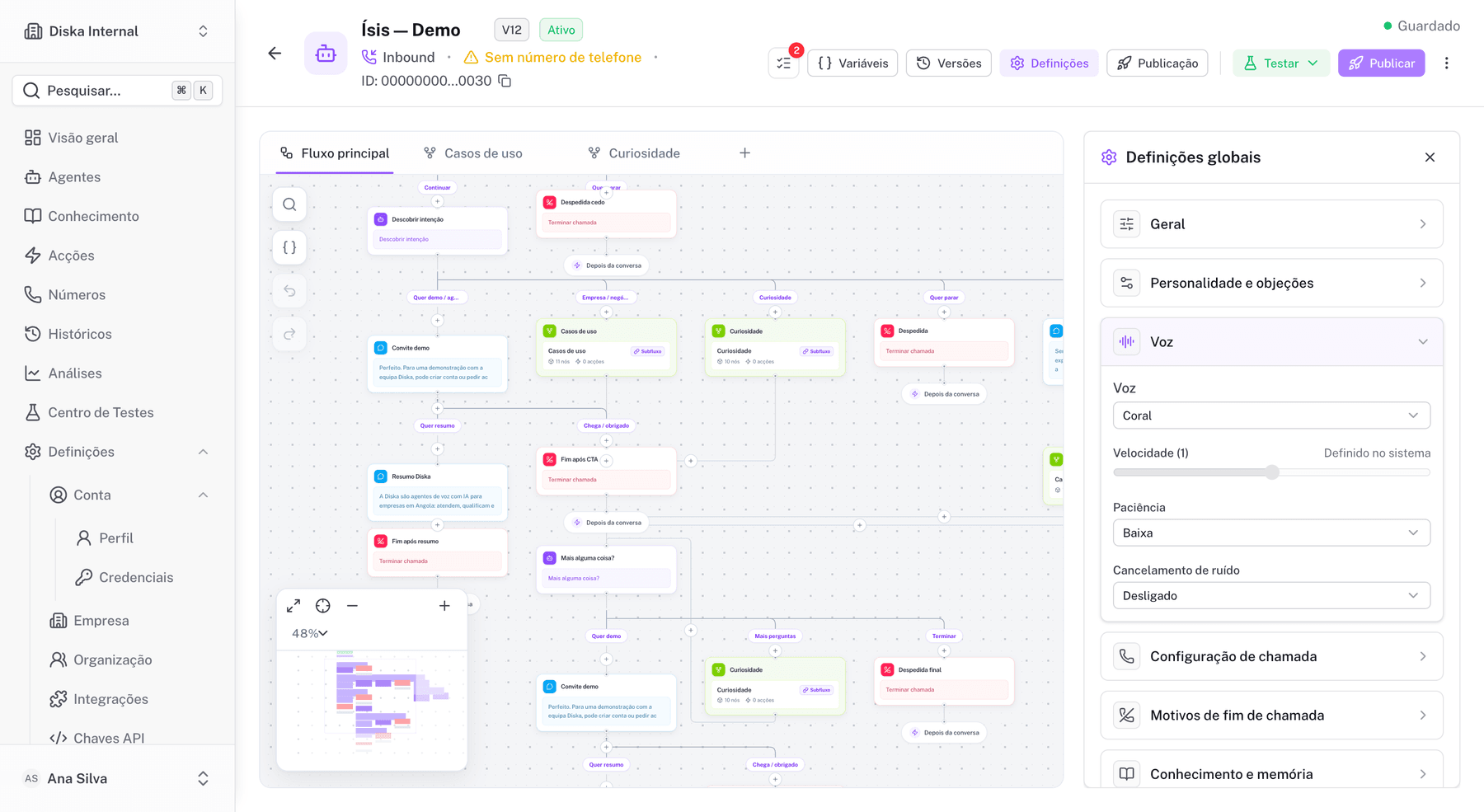
Voice providers
- Inworld Speech-to-Speech: the platform engine. It listens, reasons and speaks in one model, with no separate TTS step — this is what answers calls.
- OpenAI Realtime API + external TTS: the fallback engine. A call only lands here if Inworld is disabled or unreachable before it starts; there is never a mid-call switch. On that path the voice comes from a TTS provider (ElevenLabs, OpenAI TTS or Cartesia), which is a deployment-level setting.
Transfers and DTMF
Carrier telephony is managed by Diska and is used for:
- live transfers of an ongoing call to a phone number or SIP URI;
- sending DTMF digits (IVR) during the transfer.
There is nothing to configure on your side — carrier connectivity is managed by the platform.
Outbound dialing initiated by Diska is not available yet — it arrives with outbound telephony. "Outbound" agent types define agent behavior, not an automated dialer.
Ombala
Ombala is the SMS provider for Angola.
- SMS during a call: sent using the
during_call_smsnode. - Post-call SMS: sent after the call ends.
- Inbound SMS: received via webhook
POST /api/v1/webhooks/sms/inbound.
Transfers
Call transfers can be:
- a phone number;
- a SIP URI;
- to an internal agent.
Modes: Transferência direta (direct), Assistida (mensagem) or Assistida (resumo contextual). Configure under Acções → Transferências de chamada.
IVR and DTMF
The transfer node can perform IVR by sending DTMF digits. IVR actions are managed under Acções → IVR.
Telephony configuration
- Open the agent settings.
- In the Voz (Voice) section, pick the agent's voice from the engine's European Portuguese voices.
- Adjust patience — the silence after which the agent assumes the caller has finished their turn.